
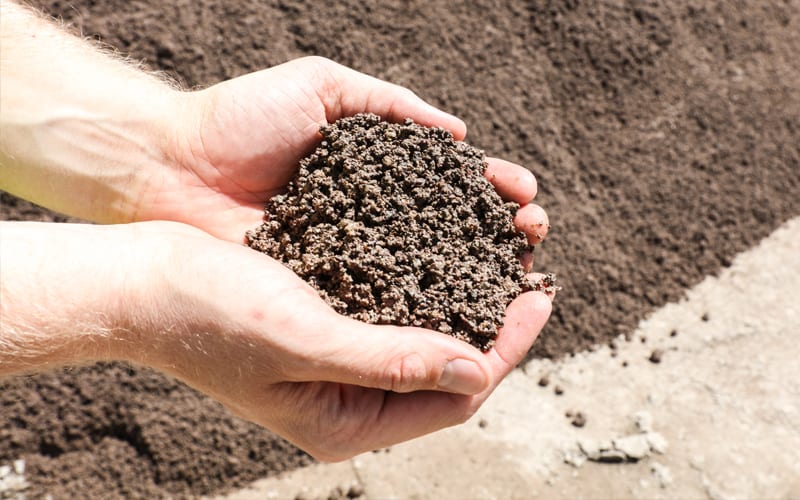
At RIG, we know that sand isn’t just sand.
Whether you’re managing a construction site, maintaining an equestrian arena, preparing a golf course, or running a busy agricultural operation, performance, consistency and reliability matter.
That’s why we’ve invested in improving our naturally recovered sand process, delivering a product that works harder across multiple applications while supporting more sustainable material choices.
What’s changed, and why it matters
Our upgraded sand benefits from enhanced washing and processing, resulting in less than 3% ultra-fines (particles smaller than 63 microns), lower organic content, a drier material with controlled moisture levels, and a more consistent particle grading across every load.
These improvements aren’t just technical details; they directly influence how the material performs in real-world applications.
From a materials science perspective, reducing ultra-fines improves permeability, allowing water to drain more freely rather than being retained within the structure of the material. Lower organic content reduces the risk of decomposition over time, which can otherwise impact stability and lead to inconsistent performance. By controlling particle size distribution, we achieve better compaction behaviour and improved load-bearing capability, while a drier product makes handling, spreading and transport far more efficient.
The result is a sand that behaves much more like a primary aggregate, predictable, stable and fit for purpose.
Equestrian: managing impact and drainage
In equestrian surfaces, the balance between shock absorption, drainage and consistency is critical.
Particle shape and grading play a key role in determining shear strength and hoof stability, helping to create a surface that feels secure underfoot. With fewer fines, the material retains less water through capillary action, reducing the risk of waterlogging and uneven conditions. Consistency across loads also helps prevent patchy compaction, which can contribute to instability or injury risk.
The outcome is a surface that offers both firmness and cushioning, supporting horse welfare as well as day-to-day performance.
Construction: Predictable compaction and strength
In construction, sand plays a critical role in applications such as mortar, render, concrete mixes and service trench backfill, where consistency and predictability are key to achieving the right result.
The performance of sand in these applications is heavily influenced by its grading, moisture content and cleanliness. By controlling particle size distribution, we help ensure more reliable mix ratios, reducing the risk of variation in strength, finish or workability. Lower levels of ultra-fines prevent mixes from becoming overly cohesive or “sticky,” making them easier to work with while maintaining the intended performance.
Reduced organic content is also important, as it helps avoid contamination that can interfere with cement hydration and long-term durability. At the same time, a drier material improves batching accuracy, meaning you’re not unknowingly introducing excess water into your mix, something that can impact both strength and curing.
The result is a sand that delivers consistent behaviour across mortar, render and concrete applications, helping teams achieve a more uniform finish, reduce rework, and maintain confidence from load to load.
Golf Courses & landscaping: Drainage and surface quality
In landscaping and sports surfaces, both drainage and visual finish are essential.
By reducing fines, the sand achieves better hydraulic conductivity, allowing water to pass through rather than sitting on the surface. Consistent grading supports an even settlement, which is key to achieving a uniform, high-quality finish. At the same time, lower organic content helps prevent degradation, maintaining the integrity of the surface over time.
The result is a cleaner, more reliable material that performs consistently across seasons.
Agriculture: Moisture management and hygiene
In agricultural settings, sand performance is closely linked to moisture control and cleanliness.
Lower water retention helps maintain drier bedding and yard environments, making day-to-day management easier and more efficient. Reduced organic content also plays an important role in limiting bacterial growth, supporting cleaner and more hygienic conditions for livestock. Consistency in the material ensures it performs reliably across a range of uses, from bedding to backfill.
This creates a practical, dependable solution that supports both livestock wellbeing and operational efficiency.
Why recycled doesn’t mean compromised
There’s often a perception that recycled materials come with trade-offs, but modern processing tells a different story.
Advanced wash plants are designed to remove contaminants and tightly control fines, while rigorous testing ensures materials meet required specifications. Where needed, traceability supported by site investigation and ground investigation data adds further confidence in material provenance and suitability.
In many cases, naturally recovered sand can offer equal, and often more consistent, performance than some natural sources, particularly where variability in primary materials is higher.
Try it for yourself
We know that performance matters most when you see it in action.
That’s why free samples are available, giving you the opportunity to trial our upgraded sand in your own environment, whether that’s an arena, site, course or farm.
If you’d like to find out more or arrange a sample, please contact Rachel Young on 07849 645483 or email rachel.young@rig-uk.com